If you’ve ever caught yourself slouching over your computer, sat up straight, and then found yourself folded over the keyboard again 10 minutes later, you already know the problem with being told to “just fix your posture.”
Posture is not something you correct once and never think about again.
Between long hours at a desk, time spent looking down at our phones, driving around Grand Rapids, exercising, carrying kids or bags, and simply going through our everyday routines, our bodies adapt to the positions we spend the most time in.
Over time, some muscles may start feeling tight or overworked while others are not being used as much. You might notice your shoulders rounding forward, your neck getting tired by the afternoon, or your lower back feeling uncomfortable after sitting.
That’s where posture correction becomes less about forcing yourself to “sit up straight” and more about helping your body move comfortably between different of positions.
Massage therapy can be part of that process.
Massage does not permanently fix posture on its own, and we would never want to promise that it does. What it can do is help relieve muscle tension, support easier movement, and make you more aware of the places where your body has been holding unnecessary strain.
When paired with movement, strengthening, stretching, and healthier daily habits, massage therapy may become a valuable part of a longer-term approach to better posture.
What Actually Affects Your Posture?
Your posture describes how your body positions itself while you sit, stand, move, and rest.
And there is no single posture you need to maintain perfectly from morning until night.
Your body is meant to move.
Problems often begin when you spend too much time in the same position, especially if that position places repeated strain on certain muscles.
Think about a typical workday.
You might:
- Sit at a computer for several hours
- Lean toward a laptop screen
- Look down at your phone
- Drive for long periods
- Sit with one leg crossed
- Carry a bag on the same shoulder
- Stand with more weight on one leg
- Repeat the same motions at work
None of these habits automatically means you have “bad posture.”
But repeating so much time in the same positions can influence how your muscles feel and how easily your body moves.
The American Massage Therapy Association discusses how desk work, electronics, sedentary habits, and repeated movement patterns may contribute to postural issues involving pain, tension, stiffness, and restricted movement. Their discussion also emphasizes that long-term improvement often involves addressing both soft-tissue restrictions and the movement patterns that helped create them.
You can read more in AMTA’s Restoring Balance article.
A few common things that can influence posture include:
- How long you remain seated
- How your workstation is set up
- Muscle tension
- Strength and mobility
- Previous injuries
- Repetitive activities
- Stress
- Exercise habits
- How often you change positions
Rather than thinking of posture as “good” or “bad,” it can be more helpful to ask:
Does this position feel comfortable, and can my body easily move out of it?
That gives you a much more useful picture of what your body may need.
How Muscle Tension Can Change the Way You Move
Muscles influence how you hold and move your body.
When certain muscles become tight or overworked, some positions may begin feeling easier than others. Eventually, you may start moving around that tension without realizing it.
For example, imagine you spend most of the day leaning toward a computer.
By late afternoon, you may notice:
- Tight shoulders
- A tired neck
- Tension between your shoulder blades
- An achy lower back
- Tight hips when you stand up
You may then adjust the way you sit or walk to avoid those uncomfortable areas.
Over time, that tension can begin to influence how you naturally position and move your body.
It does not mean one tight muscle has pulled your entire body permanently out of place. It simply means discomfort can influence the positions you choose and the way you move.
The same thing can happen after exercise.
If your hips or legs are sore after a hard workout, you might stand differently for a day or two. If one shoulder is tight, you may avoid reaching normally with that arm. If your lower back hurts, you may rely more heavily on your hips or knees when bending.
These adaptations are often temporary.
But when muscle tension becomes a daily pattern, they may stick around longer.
That is why muscle tension relief can be useful when working toward healthier posture. When movement feels comfortable again, it becomes easier to practice better movement habits.
How Massage Therapy May Support Better Posture
Massage therapy works directly with muscles and other soft tissues.
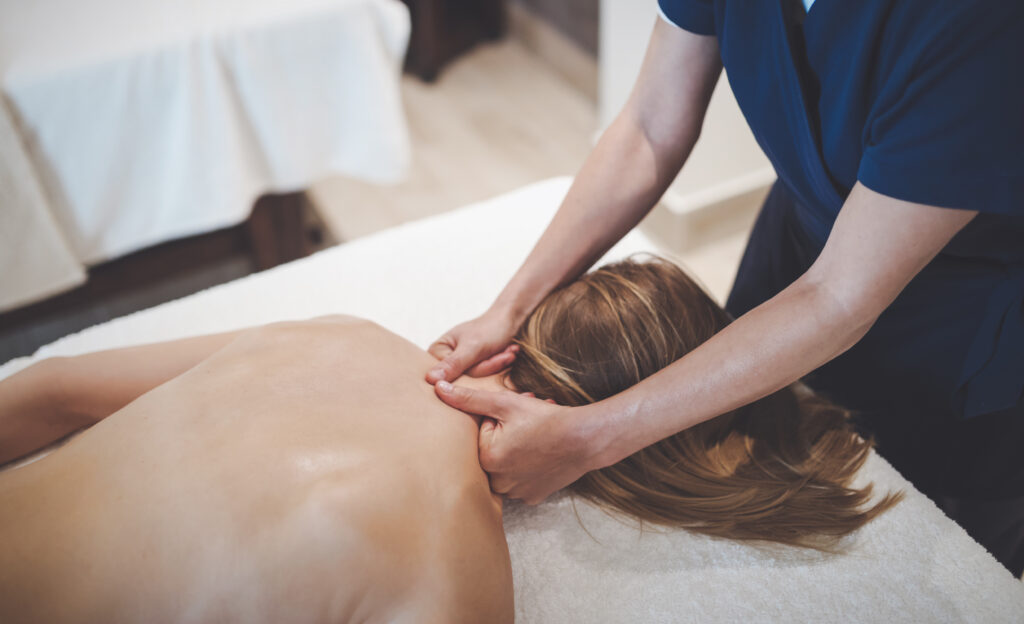
During a session, we may focus on areas that feel tight, overworked, or restricted based on your daily activities, symptoms, and movement patterns.
For someone dealing with posture-related tension, common areas may include:
- Neck
- Shoulders
- Upper back
- Chest
- Lower back
- Hips
- Glutes
The goal is not to physically force your body into a different posture.
Instead, massage may help your muscles feel relaxed enough that moving into different positions feels easier.
Some of the benefits of massage therapy for posture support may include:
- Easing muscular tightness
- Supporting comfortable range of motion
- Reducing feelings of stiffness
- Encouraging relaxation
- Helping you notice where you hold tension
- Making movement feel less restricted
- Supporting recovery from repetitive activities
This is why massage therapy for posture is best viewed as supportive care.
Research also supports taking this more balanced approach.
A systematic review and meta-analysis examining manual therapy and posture found that manual techniques may improve certain posture measures, including forward head posture, thoracic kyphosis, and pelvic alignment, particularly over the short and medium term.
That does not mean massage permanently “corrects” posture, but it does suggest that hands-on therapies may influence some posture-related measures. (You can review that research through PubMed.)
Another small randomized study involving people with mechanical neck pain and forward head posture compared two approaches.
One group received instrument-assisted soft-tissue mobilization plus exercises, while another received classical massage plus the same exercises.
Both groups experienced improvements in pain, neck movement, and strength, although the instrument-assisted treatment produced greater changes in some posture measurements.
The important part for everyday readers is that both groups were also doing exercises, as you can see here on PMC as well.
That reinforces an important point: hands-on treatment can be helpful, but movement and strengthening remain important parts of long-term posture correction.
What Might a Posture-Focused Massage Session Look Like?
There is no single “posture massage” that works for everyone.
A desk worker who spends eight hours in front of a computer may need a different approach from a warehouse employee, runner, hairstylist, nurse, or parent carrying a toddler throughout the day.
That is why we look at your experience.
Before or during your massage, it can be helpful to tell us things like:
- Where you feel tension
- When discomfort starts
- What kind of work you do
- How much time you spend sitting
- Whether you exercise regularly
- Which movements feel restricted
- Whether one side feels tighter than the other
- What you want to get out of the session
We can then customize the massage around those needs.
For example, someone who works at a desk might need extra attention around the neck, shoulders, upper back, and chest.
Someone who stands for work may notice more tension in the lower back, hips, calves, or feet.
Someone who exercises frequently might need help relaxing muscles that remain tight between workouts.
The massage should fit the person—not force every client into the same treatment approach.
Why Consistency Matters More Than a One-Time Massage
One massage can feel great.
Your shoulders may feel lighter. Your neck may turn more easily. Your back may feel less restricted.
But then Monday morning arrives.
You sit at the same desk, use the same computer, look at the same phone, and repeat the same movement patterns.
That is why long-term posture changes rarely come from a single appointment.
Your posture is influenced by what you do every day.
Regular massage may help manage recurring tension while you work on those habits between sessions.
Think of it this way:
Massage can help create an opportunity for easier movement. Your daily habits determine what you do with that opportunity.
Over time, combining massage with healthier habits may help you:
- Notice tension earlier
- Recover more comfortably from desk work
- Maintain better mobility
- Reduce recurring tightness
- Become more aware of how you sit and move
Consistency does not necessarily mean getting a massage every week forever.
Some people benefit from more frequent appointments when tension is significant and then move toward a maintenance schedule. Others find that monthly sessions work well alongside exercise, stretching, and healthy workstation habits.
There is no universal schedule.
If you work from home or spend long hours at a desk, you can also read our guide to recovering from sitting all day for more ideas on reducing posture-related tension.
Building Better Posture Beyond the Massage Table
Massage therapy can help, but most posture correction happens during the other hours of your week.
Fortunately, supporting better posture does not mean you need to think about your posture every minute of the day.
Small changes are usually more realistic.
Change Positions More Often
The best posture is often the one you have not been stuck in for the last three hours.
If possible:
- Stand up every 30 to 60 minutes
- Walk around for a few minutes
- Switch between sitting and standing
- Change your seated position
- Move your shoulders and neck
- Take phone calls while walking
Movement breaks do not need to be workouts.
Sometimes your body simply needs permission to stop holding the same position.
Adjust Your Workstation
If you work at a desk, a few small changes may reduce unnecessary strain.
Check:
- Monitor height
- Chair height
- Keyboard position
- Mouse placement
- Lower-back support
- Foot position
Your workstation should fit you, not force your body to adapt to it all day.
Watch Your Phone Position
You probably do not need us to tell you that looking down at a phone for hours can leave your neck feeling less than wonderful.
Try bringing the phone closer to eye level periodically rather than bending your neck toward it every time.
You do not have to hold it perfectly all day. Just changing positions more often can help.
Build Strength
Massage helps muscles relax, but strengthening helps your body better handle the demands you place on it.
Depending on your needs, useful areas to strengthen may include:
- Upper back
- Core
- Glutes
- Hips
- Shoulders
A physical therapist, personal trainer, or other qualified movement professional can help you choose exercises that make sense for your body.
Stretch What Feels Restricted
Gentle mobility and stretching work can complement massage.
Common areas people like to stretch after long periods of sitting include:
- Chest
- Hip flexors
- Neck
- Upper back
- Hamstrings
Stretching should feel comfortable rather than painful.
And remember: flexibility is only one part of posture. Strength, movement variety, coordination, and daily habits matter too.
Can Massage Therapy Help With Back Pain From Poor Posture?
Many people begin thinking about posture because their back hurts.

Massage therapy for back pain may be helpful when muscular tension contributes to the discomfort.
For example, massage may help when you have:
- Lower-back tightness after sitting
- Upper-back tension from desk work
- Muscle fatigue after physical work
- Tight hips that make movement uncomfortable
- Sore muscles from repetitive activities
This type of hands-on work may help relax those tissues and make movement feel more comfortable.
However, back pain can have many causes.
It can involve muscles, joints, discs, nerves, arthritis, injuries, or medical conditions. That is why ongoing or significant back pain should not automatically be blamed on posture.
A massage therapist can work with muscular discomfort, but we cannot diagnose the underlying cause of unexplained pain.
Knowing that boundary helps keep massage both useful and safe.
Body Awareness Is One of the Most Useful Posture Tools
One benefit of massage that people do not always think about is increased body awareness.
You may not realize how much tension you are carrying until someone works on that area.
During a massage, you might suddenly notice:
- One shoulder sits higher when you relax
- Your jaw has been clenched
- One hip feels much tighter
- Your chest feels restricted
- You have been holding tension in your lower back
That information can follow you into everyday life.
The next time you sit at your desk, you may notice your shoulders rising sooner.
When you drive, you may realize you are gripping the steering wheel tightly.
When you exercise, you may become more aware of one side doing more work than the other.
This kind of awareness can help because posture correction is not about someone physically placing you into the “right” position.
It is about learning how your body moves and recognizing when something feels unnecessarily strained.
When It May Be Time to Work With a Professional
Everyone feels tight or sore occasionally.
But recurring tension can be a sign that your body needs more attention.
Consider working with a massage therapist if:
- Your shoulders always feel tight
- Your neck frequently feels restricted
- Your back aches after work
- Stretching provides only temporary relief
- Certain muscles repeatedly tighten
- You feel less mobile than you used to
- Muscle tension is interfering with exercise or daily activities
Here at Be Balanced Bodywork, we can personalize your massage based on your lifestyle and what your body is experiencing.
That might mean therapeutic work on the shoulders and upper back for a desk worker, or attention to the hips and lower back for someone whose job keeps them standing all day.
However, massage is not the right answer for every posture or pain concern.
Talk with a healthcare provider or physical therapist if you experience:
- Severe or worsening pain
- Numbness or tingling
- Weakness
- Pain after a significant injury
- Sudden changes in movement
- Problems with balance
- Persistent symptoms that are not improving
A physical therapist may also be especially helpful when strengthening, movement retraining, or rehabilitation is needed.
Massage can fit alongside that care.
In fact, the research on postural interventions reinforces that combining soft-tissue care with appropriate movement and strengthening may be more useful than relying on hands-on treatment alone.
A Realistic Posture Correction Routine
If you want to improve your posture, you do not need to completely redesign your life.
A realistic routine could be as simple as:
During the workday:
- Change positions every 30 to 60 minutes
- Keep your screen at a comfortable height
- Get up for short walks
- Relax your shoulders occasionally
- Avoid staying perfectly still for hours
A few times each week:
- Strengthen your core and upper back
- Work on mobility
- Stretch areas that feel restricted
- Exercise in ways you enjoy
As needed:
- Schedule massage for recurring muscle tension
- Adjust your workstation
- Ask a professional about persistent discomfort
- Pay attention to new pain instead of pushing through it
There is no perfect checklist.
The best routine is one you can actually maintain.
Better Posture Is About Movement, Not Perfection
It is easy to treat posture like another thing we are doing wrong.
Sit straighter. Pull your shoulders back. Stop slouching. Hold your head differently.
That can become exhausting.
A healthier approach is to focus on giving your body more options.
Move frequently. Build strength. Give tight muscles opportunities to relax. Adjust your environment when it is working against you. Pay attention to discomfort instead of waiting for it to become unbearable.
Massage therapy can support that process by easing muscle tension and helping movement feel more comfortable, but it works best alongside everything you do away from the massage table.
Posture correction is not about holding one perfect pose.
It is about helping your body feel capable, comfortable, and adaptable throughout your day.
Let Us Help You Feel More Comfortable in Your Body
If posture-related muscle tension is making work, exercise, or everyday movement less comfortable, you do not have to wait until the discomfort becomes a bigger problem.
Here at Be Balanced Bodywork, we personalize each massage around what your body needs. Whether long days at a desk have your neck and shoulders feeling tight or recurring back tension is making it harder to move comfortably, our team can help you explore massage techniques that support muscle tension relief, mobility, and your broader posture goals.
Ready to give your body a little more support? Contact us today to schedule a personalized massage in Grand Rapids, and let’s work together to help you move and feel more comfortable.
FAQs About Posture Correction and Massage Therapy
Q: Can massage therapy help with posture correction?
A: Massage therapy can be a helpful addition to your routine by easing muscle tension and making movement feel more comfortable. It is not a permanent fix for posture on its own, but it may support posture correction when combined with movement, strengthening, and healthier daily habits.
Q: How often should I get a massage for posture support?
A: It depends on your individual needs, lifestyle, activity level, and how quickly tension returns. Some people benefit from more frequent sessions initially, while others use monthly massage as part of an ongoing wellness routine. We can help you think through a schedule that makes sense for you.
Q: Can massage help with back and neck tension from sitting?
A: Yes. Massage may help relieve muscular tension in areas such as the neck, shoulders, upper back, hips, and lower back that can become uncomfortable after spending long periods sitting or working in one position.
Q: What can I do to support better posture?
A: Regular movement, strengthening, gentle stretching, changing positions throughout the day, and improving your workstation can all support healthier posture. Massage can complement those habits when muscle tension makes movement uncomfortable.
Q: Does deep tissue massage correct posture?
A: Deep tissue massage does not permanently correct posture. It may help relieve deeper areas of muscular tension for some clients, which can make movement feel easier. Whether deep tissue work is appropriate depends on your comfort, symptoms, and goals.
Q: Is there one correct posture I should maintain all day?
A: Not necessarily. Your body is designed to move, and staying in any one position for a very long time can become uncomfortable. Instead of trying to hold a perfect posture all day, focus on comfortable alignment, regular movement, and changing positions frequently.
Q: Should I see a massage therapist or physical therapist for posture problems?
A: It depends on what you are experiencing. Massage therapy can help with muscular tension and comfort. A physical therapist may be more appropriate when you need rehabilitation, strengthening, movement retraining, or evaluation of persistent pain or functional limitations. In many cases, the two approaches can complement one another.