You probably don’t think about your breathing very often– but you do it more than 17,000 times every day. Each breath has the potential to influence how your body feels.
Most of those breaths happen without any conscious effort, which makes it easy to overlook how much your breathing patterns influence muscle tension, posture, and how your body responds to stress.
This means you have about 17,000 opportunities to affect how your body feels every single day.
In an ideal breathing pattern, your diaphragm does most of the work.. Your ribs expand, your shoulders remain fairly relaxed, and your body gets the air it needs without creating a lot of extra effort.
Stress, pain, poor posture, and prolonged sitting can all change the way you breathe. You may start breathing more quickly or more shallowly, relying more heavily on the muscles in your neck, shoulders, and upper chest. Over time, this extra effort may leave your neck and shoulders feeling tight, sore, or constantly tense..
This does not mean every sore shoulder is caused by the way you breathe. Muscle tension can have many causes. But breathing, posture, stress, and movement are closely connected, and one pattern can influence the others.
This guide explains how breathing patterns affect the body, why shallow breathing may contribute to muscle tension, and how massage therapy may support relaxation and more comfortable movement.
How Breathing Patterns Affect Your Body
Breathing is much more than simply taking in oxygen. Every breath requires several muscles working together. It relies on your diaphragm, ribs, chest, abdomen, and several supporting muscles moving together.
Your diaphragm is the main muscle used for breathing. It sits beneath the lungs and moves downward as you inhale, creating room for the lungs to expand. When you exhale, the diaphragm relaxes and moves upward again.
Other muscles can assist when your body needs more air, such as during exercise. These are sometimes called accessory breathing muscles. They include muscles in the neck and upper chest.
Accessory muscles are useful. The problem comes when they begin doing more work than necessary during ordinary, relaxed breathing.
Everyday habits and health conditions can change how you breathe, including:
- Stress or anxiety
- Pain
- Poor posture
- Long periods of sitting
- Habitual slouching
- Injury
- Respiratory illness
- Fatigue
- Intense physical activity
- Holding your breath while concentrating
For example, someone hunched over a computer may have less room for the ribs and abdomen to move comfortably. They may respond by taking smaller breaths into the upper chest.
Someone who is stressed may breathe more quickly without realizing it. Their shoulders may lift with every breath, and the muscles around the neck may remain slightly tense.
These habits can gradually contribute to physical discomfort, especially when they happen for hours every day.
Why Shallow Breathing Can Lead to Muscle Tension
Shallow breathing usually means taking smaller breaths that rely more heavily on movement in the upper chest.
During stress, this can feel like:
- Breathing mainly into the chest
- Lifting the shoulders while inhaling
- Taking quick, frequent breaths
- Holding the breath between tasks
- Sighing often
- Feeling unable to take a satisfying deep breath
When the diaphragm is not doing as much of the work, muscles in the neck, shoulders, and upper chest may have to assist more frequently.
These muscles may include:
- Muscles along the sides of the neck
- Muscles connecting the neck to the upper ribs
- The upper trapezius muscles
- Muscles across the chest
- Muscles between and around the ribs
Repeatedly using these areas to support everyday breathing may contribute to shoulder tension, neck tightness, or fatigue across the upper body.
You might notice:
- Shoulders that feel lifted or heavy
- Tightness near the base of the neck
- Soreness across the upper chest
- Tension between the shoulder blades
- A frequent urge to stretch or roll your shoulders
- Headaches that appear after stressful days
Shallow breathing is not always something you can simply decide to stop. It may have developed gradually in response to stress, pain, posture, or a medical condition.
Improving breathing awareness can be helpful, but it should not become another thing to worry about. The goal is not to take a perfect breath every time. It is to give your body more opportunities to relax and move naturally.
The Connection Between Stress, Breathing, and Muscle Tightness
Stress changes the way the body prepares for action.
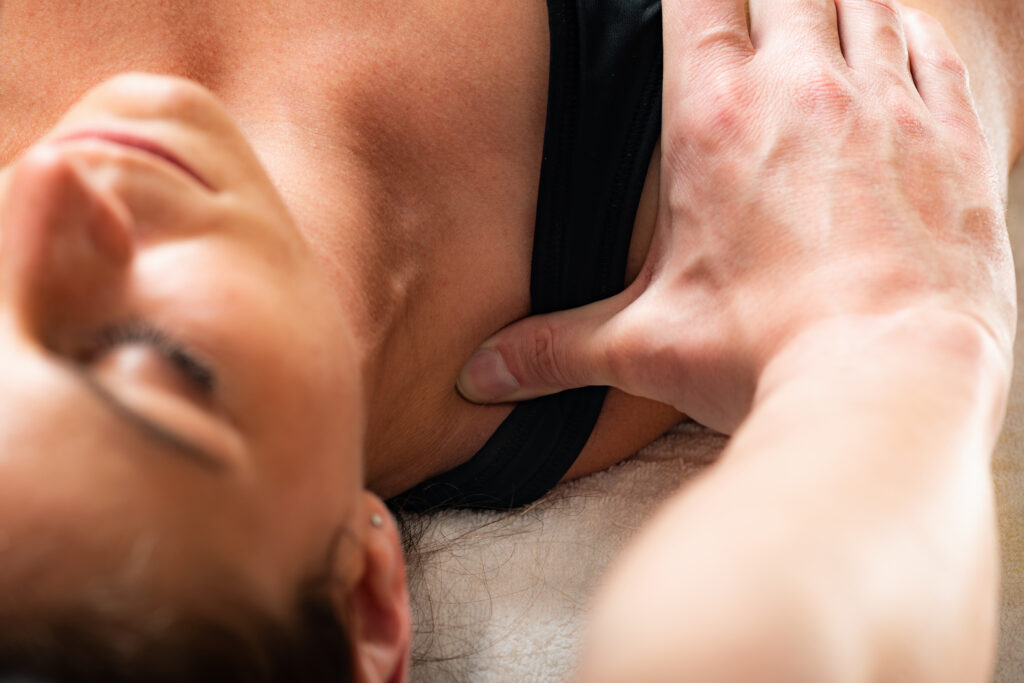
When your nervous system senses pressure or danger, your heart rate may increase, your breathing may speed up, and your muscles may tighten. This is part of the body’s natural stress response.
That response is useful when you need to act quickly. It becomes more difficult when the stress continues throughout the day.
Modern stress may come from:
- Work deadlines
- Family responsibilities
- Financial concerns
- Constant phone notifications
- Long commutes
- Poor sleep
- Emotional pressure
- Feeling like you always need to be productive
You may not be running from immediate danger, but your body can still react as though it needs to stay alert.
This can create a cycle:
- Stress makes breathing faster and shallower.
- Shallow breathing places more demand on upper-body muscles.
- Tight muscles make breathing and posture feel less comfortable.
- Physical discomfort creates more stress.
- The body stays tense.
Over time, this cycle can contribute to chronic muscle tension in areas like the neck, shoulders, jaw, chest, and upper back.
This is why emotional stress can feel so physical. It may show up as headaches, jaw clenching, sore shoulders, poor posture, fatigue, or the feeling that you cannot fully relax.
A massage for stress relief may help interrupt this cycle by giving both the muscles and nervous system time to settle.
How Massage Therapy Encourages Relaxation
Massage therapy does not directly teach the lungs how to breathe, and it should not be considered a treatment for respiratory disease. What it may do is reduce some of the muscular and emotional tension that makes relaxed breathing feel more difficult.
During a massage session, gentle, intentional techniques can help muscles relax while encouraging your nervous system to shift into a calmer state.
As the body becomes more comfortable, many people naturally begin breathing more slowly and deeply without being told to do so.
Massage therapy may support relaxation by:
- Easing tight muscles in the neck and shoulders
- Reducing tension across the upper back and chest
- Encouraging a calmer nervous system state
- Improving awareness of where the body holds stress
- Supporting more comfortable posture
- Giving the body time away from daily stimulation
A relaxation massage may be especially helpful when tightness is closely connected to stress. Gentle, rhythmic techniques can create a setting where you feel safe enough to let your shoulders drop and stop bracing.
This does not mean massage will correct every inefficient breathing pattern. But when tight muscles and stress are part of the problem, reducing that tension may help breathing feel less restricted.
The American Massage Therapy Association discusses massage as a possible complement to conventional care for people with asthma, particularly for relaxation and relief from secondary muscle tension. The organization also makes it clear that massage cannot replace medications or emergency care during an asthma attack.
Read more in AMTA’s article, Breathe Easier: Asthma and Massage.
Want to learn more about how stress affects the body? Read Be Balanced Bodywork’s guide on how stress physically causes muscle tension and how massage helps.
How Massage Supports Body Awareness
One of the less obvious benefits of massage is that it gives you a chance to notice your body.
During a busy day, you may not realize that you are:
- Holding your breath while answering emails
- Lifting your shoulders while driving
- Clenching your jaw during stressful conversations
- Tightening your stomach while concentrating
- Leaning forward for hours at a desk
A massage session slows things down enough for those patterns to become easier to notice.
You may suddenly realize how much tension you have been carrying in your shoulders. You may notice that your breathing becomes fuller once your upper back relaxes. You may recognize that one side of your body feels more restricted than the other.
That awareness can be valuable after the appointment too. Once you know where you tend to hold stress, you can begin checking in with those areas throughout the day.
Massage does not create instant posture or breathing perfection. It can, however, help you reconnect with physical signals that are easy to ignore when life gets busy.
Building Better Breathing and Recovery Habits
Changing a long-standing breathing or tension pattern takes time.
Trying to force yourself to breathe deeply all day may actually create more tension. A better approach is to create small opportunities for comfortable breathing, movement, and relaxation.
Change positions regularly
Staying in one position for too long can make the chest, hips, back, and shoulders feel restricted.
Try to:
- Stand up every 30 to 60 minutes.
- Take a short walk.
- Change your seated position.
- Stretch your arms overhead.
- Gently roll your shoulders.
The goal is not an intense workout. It is simply to remind your body that it is allowed to move.
Check your posture without becoming rigid
Good posture does not mean sitting perfectly straight and tense all day.
A comfortable position may include:
- Feet supported
- Shoulders relaxed
- Screen near eye level
- Lower back supported
- Elbows resting comfortably
- Head positioned over the shoulders
The best posture is often the next posture. Changing positions is generally more realistic than holding one “perfect” position for hours.
Practice comfortable breathing
Take a moment to notice your breath without trying to judge it.
You might place one hand on your chest and one on your abdomen. Notice which hand moves more. Then allow the breath to become a little slower and easier.
Try:
- Breathing in gently through your nose
- Allowing the lower ribs and abdomen to expand
- Exhaling slowly without forcing the air out
- Keeping your shoulders relaxed
- Repeating for a few comfortable breaths
Stop if you feel dizzy, lightheaded, or uncomfortable.
Stretch the upper body gently
Helpful movements may include:
- Chest-opening stretches
- Gentle neck turns
- Shoulder rolls
- Upper-back stretches
- Side bends
- Thoracic rotation
Stretching should feel comfortable. Sharp pain, numbness, or tingling is a reason to stop.
Build a realistic wellness routine
Long-term improvements often come from several habits working together:
- Regular movement
- Quality sleep
- Stress management
- Hydration
- Supportive posture
- Mindful breathing
- Massage therapy
- Medical or physical therapy care when needed
For a deeper look at the mind-body relationship, read Be Balanced Bodywork’s guide to health and wellness massage for mental health.
When Deep Tissue Massage May Be Helpful
If muscle tension has been building for months– or even years– a deep tissue massage may be worth considering..
This approach uses slow, focused techniques to work with deeper layers of muscle and connective tissue. A therapist may address areas such as the upper back, shoulders, chest, or muscles surrounding the ribs when appropriate.
Deep tissue work may be considered when you have:
- Long-term shoulder tightness
- Upper-back tension
- Posture-related restriction
- Muscle soreness that keeps returning
- Areas that do not respond to gentle stretching
- Tension related to repetitive work or activity
Deep tissue massage is not automatically the best choice for every person.
If your body is already highly stressed, sore, or sensitive, a gentler massage may be more comfortable and effective. Pressure should always be adjusted based on your health, preferences, and response during the session.
A small nonrandomized pilot study examined 40 healthy young adults who received either deep tissue or classic massage. The researchers observed changes in chest expandability and some respiratory measurements after one session, but they also emphasized that more research is needed.
The study does not show that deep tissue massage treats breathing disorders.
A key takeaway is not that everyone with shallow breathing needs deep tissue massage.
However, the mobility of muscles and connective tissues around the chest may influence breathing mechanics, and personalized bodywork may be helpful when those tissues feel restricted.
When Breathing Changes Need Medical Attention
Stress-related shallow breathing is common, but shortness of breath can also be a symptom of a medical condition.
Massage should never be used instead of medical evaluation for new, severe, or unexplained breathing difficulties.
Seek urgent medical care for symptoms such as:
- Sudden or severe shortness of breath
- Chest pain or pressure
- Blue or gray lips or skin
- Confusion
- Fainting
- Severe wheezing
- Difficulty speaking because of breathlessness
- Breathing trouble after an allergic reaction
- Symptoms that quickly become worse
Make an appointment with a healthcare provider if breathing changes are persistent, recurring, or interfering with everyday activity.
Bluegrass Care Navigators has shared an example of massage being used as comfort-focused integrative care for a patient experiencing shortness of breath.
That story may be meaningful, but it should be understood as an individual care experience rather than proof that massage treats the underlying cause of breathlessness.
People with asthma, COPD, heart conditions, or other respiratory concerns should talk with their healthcare provider before treating massage as part of their care plan.
Breathe Easier Today and Let Your Body Relax
Your breathing patterns, posture, stress level, and muscle tension are more connected than they may seem.
When stress leads to faster or shallower breathing, the neck, shoulders, and upper chest may begin working harder. Over time, this can contribute to shoulder tension, neck tightness, poor posture, and chronic muscle discomfort.
Massage therapy may help by relaxing overworked muscles, encouraging body awareness, and giving your nervous system a chance to settle. Paired with regular movement, comfortable breathing exercises, healthy posture habits, and appropriate medical care, massage can become a meaningful part of your wellness routine.
If stress, shallow breathing, or ongoing muscle tension is making it difficult to feel comfortable in your body, our team at Be Balanced Bodywork is ready to help.
Schedule a personalized massage in Grand Rapids today and let us help ease neck and shoulder tension, support relaxation, and find the massage approach that fits your need to breathe easier.
FAQs
Q: What is a healthy breathing pattern?
A: Breathing patterns describe how quickly and deeply you breathe, where movement occurs in your body, and which muscles assist with each breath.
Q: Can poor breathing patterns cause muscle tension?
A: Shallow or upper-chest breathing may place additional demand on muscles in the neck, shoulders, and chest. Over time, this can contribute to tension, especially when combined with stress or poor posture.
Q: Can massage therapy help with stress-related tension?
A: Massage therapy may help relax tight muscles, encourage a calmer nervous system state, and support relief from physical tension related to stress.
Q: Is deep tissue massage the best option for muscle tension?
A: Not always. Deep tissue massage may help certain areas of long-standing tightness, but some people respond better to lighter or relaxation-focused techniques. A massage therapist can recommend an approach based on your comfort and goals.
Q: Can massage treat shortness of breath or asthma?
A: Massage does not treat the underlying medical causes of shortness of breath or replace asthma medication. It may provide relaxation and help with secondary muscle tension when used alongside appropriate medical care.